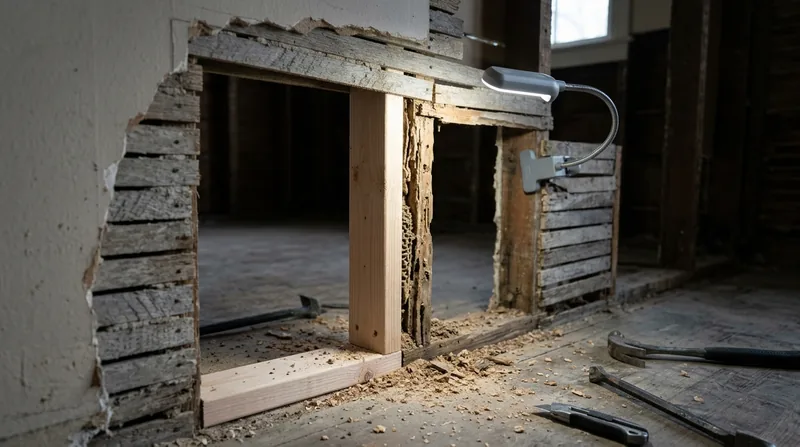




Western subterranean termites are a persistent presence in Santa Rosa's older residential neighborhoods, especially in the raised-floor homes that line McDonald Avenue, populate the St. Rose and West End historic districts, and cluster around Railroad Square and Burbank Gardens. When a pest inspector finds termite damage, the exterminator treats the colony, but the eaten wood remains. Termite damage repair in Santa Rosa means replacing the studs, sills, rim joists, subfloor sections and trim that termites have hollowed out, restoring full structural integrity to floors, walls and exterior elements. We work from your pest inspection report, remove the compromised wood, and install new framing or finish pieces that meet the original load and finish standard. The work is straightforward carpentry, but it demands precision: a poorly sistered joist or a sill plate installed without proper bearing will fail under load or invite future moisture problems. This guide explains what termite damage looks like in Santa Rosa homes, how we repair it, what it costs, and how to find a carpenter you can trust.
Why Termite Damage Repair Matters in Santa Rosa's Older Homes
Santa Rosa's housing stock spans over a century, and the oldest and most vulnerable homes sit on raised foundations over crawlspaces. The adobe clay beneath the Santa Rosa Plain swells in winter rain and shrinks in dry summers, pulling foundations and floors out of level and creating stress cracks that invite moisture and termites. Western subterranean termites tunnel through soil and wood, eating the interior of studs, joists and sill plates while leaving a thin shell of sound wood on the outside. By the time damage is visible (soft spots, sagging floors, hollow-sounding trim), significant structural wood has already been consumed. Leaving termite damage in place guarantees progressive failure: floors sag further, doors and windows jam, and the risk of localized collapse increases over time. Repairing the damage promptly stops the deterioration and restores the safety and usability of the affected floor, wall or exterior element.
- We remove termite-eaten studs, rim joists and sill plates and install new framing that carries the full load of the structure above.
- We replace subfloor sections that have lost bearing capacity, using new material that matches the original span and thickness.
- We repair or replace exterior trim, fascia and sill boards that termites have damaged, restoring weather resistance and finish appearance.
- We document the scope of repair for insurance claims, helping you file and support your damage report with the carrier.
Addressing termite damage promptly also prevents secondary failures: a sagging floor can cause doors to jam and plumbing to kink; a compromised rim joist can allow further moisture entry; and soft exterior trim invites water into the wall cavity behind it. For more information on pest control and inspection standards in Santa Rosa, the City of Santa Rosa Building and Safety Department publishes guidance on structural pest inspections and reporting requirements.
Key info: Termite damage is common in Santa Rosa homes built before 1960, especially those with wood sill plates in direct contact with soil or within 18 inches of grade. A licensed pest inspector's report is the starting point for repair scope and cost estimation.
How We Repair Termite Damage: Our Process in Santa Rosa
Termite damage repair begins with your pest inspection report, which identifies the location and extent of damage and the species involved. We inspect the affected wood in person, probe for soft spots and measure the depth of damage to determine whether repair or replacement is the right choice. For studs, joists and sill plates, we typically remove the damaged section and sister a new piece alongside it, or remove and replace the entire member if damage is extensive. For subfloor and finish trim, we cut out the damaged portion and install new material that matches the original species, dimension and finish. All new wood is installed with proper fastening, bearing and ventilation to prevent future moisture and pest problems. The work is done in stages: removal and inspection first, then framing or structural repair, then finish work and final inspection.
- We inspect the damage on site, probe the wood to confirm the depth and extent, and document the scope in writing.
- We remove the damaged wood carefully, protecting adjacent structure and utilities, and inspect the cavity for additional hidden damage.
- We install new framing or subfloor material, ensuring proper bearing, fastening and alignment with the original structure.
- We seal the new wood with finish or paint to match the original, and inspect the repair for structural soundness and water tightness.
We also check for related damage: a termite-eaten sill plate often signals moisture accumulation that may have softened adjacent rim joists or floor framing. See our page on floor joist and subfloor repair for details on larger framing jobs.
Local example: A Fountaingrove home built in 1955 had termite damage in the rim joist and two floor joists under a bathroom. We removed the damaged joist section, sistered a new pressure-treated joist alongside it, and replaced the rim joist where it met the sill plate. The floor leveled out, the bathroom no longer flexed underfoot, and the homeowner was able to file an insurance claim with photos and a detailed repair invoice.
Repair Methods and Approaches for Termite Damage
| Approach | Description | Best for |
|---|---|---|
| Sistering | Install a new framing member alongside the damaged one, fastened securely with bolts and nails, carrying shared load. | Partial damage to floor joists, rim joists or studs where the undamaged portion retains adequate strength. |
| Full Member Replacement | Remove the entire damaged stud, joist or sill plate and install a new member of the same species and dimension. | Damage that extends more than one-third of the joist depth or length, or where sistering is not structurally feasible. |
| Subfloor Patching | Cut out the damaged section of subfloor and install new plywood or boards, fastened to the joists below and feathered at edges. | Localized damage to subfloor that does not affect joist bearing or span, typically under 4 square feet. |
| Trim and Fascia Replacement | Remove the damaged exterior trim, fascia, soffit or sill board and install new material in matching species and profile. | Termite damage to non-structural exterior wood, or damage that affects weather tightness and appearance. |
The choice of method depends on the location and depth of damage, the load the member carries, and whether the undamaged portion has enough strength to share the load with a new sister member. We explain the trade-off between cost and durability on site and recommend the repair that gives you the best value over time.
Termite Damage Repair Cost in Santa Rosa: What to Expect
Termite damage repair in Santa Rosa typically starts at around $1,200 for small, localized repairs such as a single damaged stud or a small subfloor patch in an accessible crawlspace. Larger jobs, such as replacing multiple joists or a full rim joist section, generally range from $2,500 to $6,000, depending on the extent of damage, the accessibility of the work area, and whether the repair requires sistering or full member replacement. The cost of the repair is driven by several concrete factors: the number and size of damaged members, how deep the termite damage extends into the wood, how accessible the damage is (crawlspace work is faster than working in a tight basement or over a finished ceiling), and whether the repair requires a structural engineer's input or a building permit.
Getting 2 or 3 estimates from local carpenters is smart practice. Each estimate should itemize the damaged members, specify the repair method (sistering vs. replacement), note any structural or permit considerations, and explain what is and is not included in the price. Travel and materials are typically included in Santa Rosa and the surrounding areas; some carpenters charge extra for mileage beyond Sonoma County, so ask. We provide a free estimate within 24 hours and can walk you through the factors that affect your specific repair. For a detailed pricing breakdown and examples, see our full pricing page.
Insurance often covers a portion of termite damage repair if you have a homeowner's policy that includes structural pest damage. We can help you document the damage and repair scope for your claim, but the decision to approve and pay for the work rests with your carrier and your policy terms. Check your policy and contact your agent to confirm coverage before work begins.
Termite Damage Repair Near Me: What Santa Rosa Homeowners Should Know When Hiring a Carpenter
Finding a trustworthy carpenter for termite damage repair means looking for someone with hands-on experience in structural carpentry, a clear understanding of how Santa Rosa's older homes are built, and a willingness to explain the repair method and why it makes sense for your specific damage. Ask for references from recent jobs in Santa Rosa or nearby towns, and call them to ask how the repair has held up and whether the carpenter was professional and thorough. Verify that the carpenter carries liability insurance and is fully insured; ask for a certificate of insurance if you are filing a claim with your homeowner's policy. Get the repair estimate in writing, with a detailed scope of work that identifies each damaged member, specifies the repair method, and lists materials and labor separately.
If your repair involves structural changes (removing or altering a load-bearing wall, replacing multiple beams or joists, or significantly altering the floor structure), check whether your local building department requires a permit. Santa Rosa's Building and Safety Division publishes permit thresholds on their website; when in doubt, call them directly to confirm. Some neighborhoods in Santa Rosa (such as the St. Rose and West End historic districts) have additional design review requirements, and homeowners associations may have approval processes for exterior repairs. A good local carpenter will know these requirements and help you navigate them. Call us at (707) 543-1462 for a free estimate or to discuss whether your repair needs a permit or engineer's input. See our contact page to request an estimate online.
Termite Damage Repair in Santa Rosa: Pricing Guide
| Service | Price | Details |
|---|---|---|
| Small localized repair (single stud, small subfloor patch) | Starting at $1,200 | Includes removal, installation of new member or patch, fastening and finish in accessible crawlspace or wall cavity |
| Medium repair (two to four joists, rim joist section, or multiple studs) | Starting at $2,500 | Sistering or full replacement of multiple members, structural inspection, and finish work to match existing floor or wall |
| Large or complex repair (multiple floor joists, sill plate replacement, or hard-to-access damage) | Starting at $4,500 | Full structural repair with possible engineering input, permit coordination, and restoration of level floors and proper bearing |
| Exterior trim or fascia repair (multiple boards, siding damage, or weather tightness restoration) | Starting at $1,800 | Removal and replacement of damaged exterior trim, fascia or sill boards, finished to match original species and profile |
| Free estimate | No cost or obligation | Response within 24 hours at (707) 543-1462, on-site inspection, written scope and pricing for your specific damage |
Indicative pricing, the exact cost depends on square footage, finish, and site access. Free personalized estimate within 24h at (707) 543-1462.


